Photo: Shoko Festival, via shokofestival.co.zw.
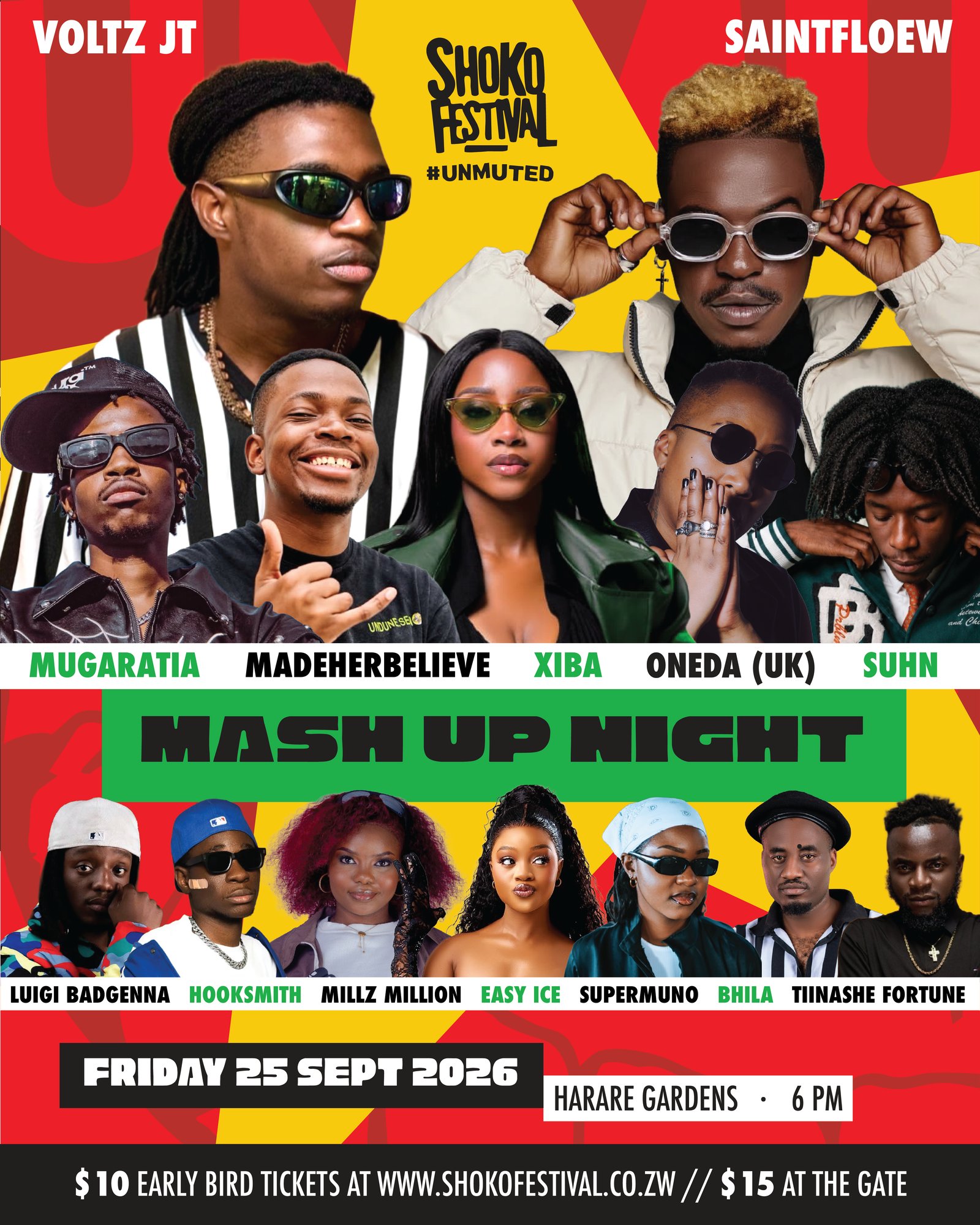
Every rapper on Shoko Festival's Mash Up Night bill this year gets a full live band behind them. Not a DJ, not a backing track with the recorded vocal still sitting in the mix. A band.
That is a small line in a festival programme and a big statement about where Zim hip hop is being pushed. Shoko's 16th edition runs from 24 to 26 September across Harare and Chitungwiza under the theme Unmuted, organised as always by Magamba Network.
Who is on the Mash Up bill
Mash Up Night lands on 25 September at Harare Gardens. Saintfloew, Voltz JT, Xiba and Bulawayo's Bhila headline, with Mugaratia, Supermuno, Millz Million, Easy Ice, Luigi Badgenna, Hooksmith and DJ Madeherbelieve filling out the night.
Saintfloew, Xiba and Bhila are headlining the night for the first time, arriving off chart singles like Uchazondida and Gucci N Dior in Saintfloew's case. Voltz JT returns as the one with the longest relationship with the stage, and the sharpest pen on the bill. Bhila is not a rapper at all, bringing a fusion of Afro soul and mbaqanga, which is the entire point of a night built on collaboration across genres rather than a straight rap showcase.
Mash Up Night curator Dennis Shoko has been explicit that the programme was designed to give audiences something other than a standard club appearance, which is the polite version of the problem the live band is there to solve.
The backing track problem
Zim hip hop's live weakness is not a secret. The default set is an artist over a pre recorded instrumental, often with the album vocal audible underneath, run for twenty minutes and off. Mhepo, covering this year's lineup, framed the band decision as the festival refusing to let the genre stagnate into repetitive DJ sets, and that is a fair reading.
A band changes the economics of a performance. Songs have to be arranged rather than played. Rehearsal becomes non negotiable. Tempo can move, a verse can be extended, and the audience gets something that cannot be reproduced by pressing play. It also exposes anyone who cannot actually hold a stage, which is the useful part.
The honest caveat is cost. Bands are expensive, rehearsal time is expensive, and a festival with donor and partner backing can absorb that in a way a promoter booking a Friday night in Avondale cannot. Whether any of this survives past 25 September is the real test.
Mashoko Tapes is the part nobody talks about
Which is where the less visible piece comes in. Magamba runs a residency called Mashoko Tapes that takes Mash Up Night performers into a studio together to make an original album, rather than putting them on one stage for one night and sending them home.
Read the two together and the festival looks less like a booking and more like a deliberate attempt to build something that outlasts the weekend. Collaboration on a record binds artists who otherwise circle each other from separate camps, and a finished album keeps earning after the stage is packed away.
The rest of the weekend
Comedy Night opens things on 24 September at Harare Gardens, headlined by Nigel Maritinyu, better known as Nigel Tha Slick Pastor, with Chipenzi and Neville Bird, hosted by Sharon Chideu.
The Green Cities Expo runs on 25 September at Harare Gardens Green with free entry, built around sustainable urban space and climate work. The Hub Unconference carries the talks programme, and the festival closes with Peace in the Hood in Chitungwiza. Full listings for each are going up separately on our events page.
Sixteen years is the actual achievement
Festivals in Zimbabwe do not usually get to sixteen. Shoko has, and the list of things that have run through it says why it matters beyond a single night's lineup: the Comedy Roast, the Women's Cypher, Voice2Rep, an augmented reality exhibition, a gaming and cosplay hub. Its Hub Unconference has hosted Black Lives Matter co-founder Ashley Yates, the satirist Gado, and journalists from CNN and Al Jazeera.
The themes track the mood of the moment too. The Take Back in 2023, Decolonize the Internet on the Hub programme last year, Unmuted this time. Whatever else the festival is, it has kept reading the room for a decade and a half.
So the thing to watch is not whether 25 September goes well. It is whether a rapper who has just played a stadium sized Harare Gardens set with a band behind them is willing to go back to a laptop and a hype man in November. If a few of them are not, Shoko will have changed something.
Sources
- Zim hip-hop takes centre stage at Shoko Festival, The Standard
- Nigel Tha Slick Pastor to Headline Star-Studded Shoko Comedy Night, 263Chat
- Shoko Festival 2026: Saintfloew, Voltz JT & Xiba Headline Mash Up Night, Mhepo
- About Us, Shoko Festival official site
- Star-Studded Line-Up for Shoko Festival's 15th Edition, 263Chat via allAfrica
Researched and drafted with the help of AI tools, then fact-checked and edited by our team. How we work.