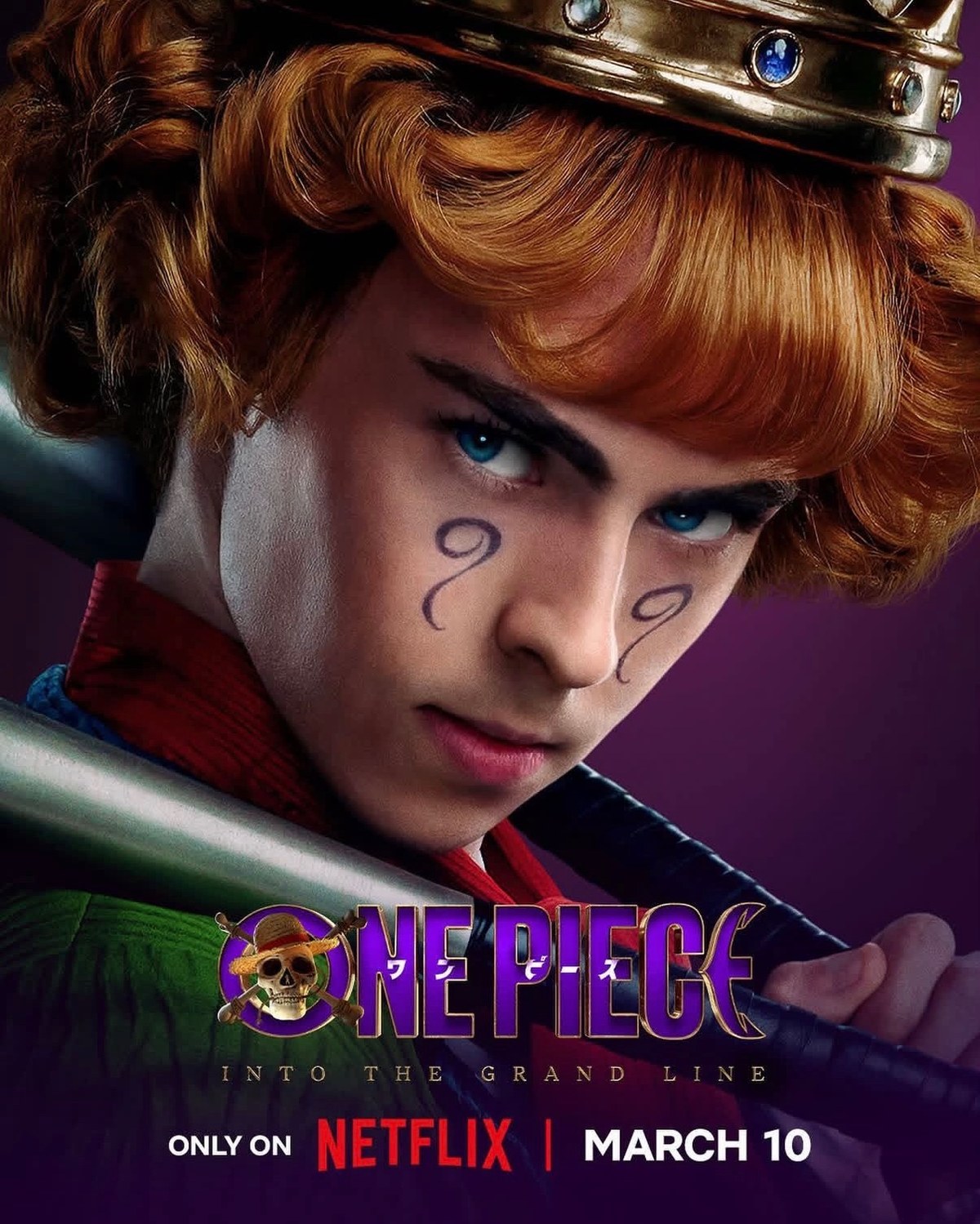
Photo: Daniel Lasker as Mr. 9 in One Piece, via IMDb.
A crown, princely dress and twin metal baseball bats. That is Mr. 9, the Baroque Works frontier agent who turns up early in the Straw Hats' run at the Grand Line, and the man playing him taught himself to make films in a city with no film industry to speak of.
Daniel Lasker was cast in season two of Netflix's live action One Piece alongside Camrus Johnson as Mr. 5, Jazzara Jaslyn as Miss Valentine and David Dastmalchian as Mr. 3, in a casting Variety broke. The season, subtitled Into the Grand Line, went up worldwide on 10 March 2026 with all episodes released at once, adapting the Loguetown, Reverse Mountain, Whiskey Peak, Little Garden and Drum Island arcs. Netflix had already ordered a third season before the second one aired.
A show that hit number one in fifty countries
Some scale on what he walked into. The first season launched in August 2023 and climbed into Netflix's global top ten, reaching the number one slot in close to fifty countries, with more than 285 million hours watched inside a fortnight. Critics gave it 86 per cent on Rotten Tomatoes against a viewer score of 95. Netflix renewed it two weeks after release.
Baroque Works is the first proper villain organisation the crew runs into, which makes Mr. 9 a small part of a very large machine. Lasker's own response to the casting was that stepping into a world he already loved was a dream, and that he was pinching himself.
No industry to join, so he built one for himself
The more interesting part of the story sits behind the credit. Lasker grew up in Bulawayo, and by his own account on IMDb there was no active film industry there to apprentice into, so he taught himself to make his own films. Those films found an audience with Zimbabwean viewers first and foreign festivals after.
He directed what My Afrika Magazine describes as Zimbabwe's first Ndebele language sci-fi short. It won Best Short Film at the New York Sci-Fi Festival and at the Zimbabwe International Film Festival, and the Bulawayo Arts Awards have recognised him across directing and acting categories. The acting credits stacked up in parallel: Raised by Wolves on HBO, Noughts and Crosses on BBC One, Vagrant Queen on SYFY.
So the One Piece casting is not a lucky break landing on an unknown. It is the point at which a decade of self directed work met a production big enough for everyone else to notice.
The screening that mattered more than the streaming numbers
Asked by Digital Journal to name a defining moment in his career, Lasker did not pick a set or a premiere. He picked a screening of his sci-fi short The Signal at ZimKids Orphanage in Bulawayo. The children were delighted to watch something made in their own city and in Ndebele, he said, and afterwards a number of them decided they wanted to be filmmakers and actors, and started making their own skits, short films and videos.
That is the whole argument for a local film industry, told in one anecdote. Kids do not aspire to a job they have never seen anybody in their city do.
Cape Town got the shoot, and that is the catch
Season two was filmed in Cape Town, which TechRadar confirmed when production began. Good news for the continent, and worth being precise about who benefits: the crew jobs, the studio hire and the training days all land in South Africa.
The contrast is stark. Netflix marked ten years in South Africa this month with a 2026 slate that includes Blood Legacy season two on 25 September, a local edition of Love Is Blind, and a claim of more than 300 South African titles released over the decade, filmed across 20 cities. Zimbabwe has no equivalent pipeline, no comparable slate, and nothing like that volume of paid production days.
Which is why the working route for a Zimbabwean actor or director is still the one Lasker took: build the credits somewhere else. He did it from Bulawayo with no formal industry, no studio system and no commissioning body behind him, and still ended up in a global cast. Talent was never the missing piece here. The missing piece is everything that would let the next Daniel Lasker do it without leaving.
For now, the evidence that it works sits in an orphanage in Bulawayo, where a group of kids watched a science fiction film in their own language and went off to make their own.
Sources
- 'One Piece' Casts Baroque Works Agents Mr. 3, Miss Valentine, Mr. 5 & Mr. 9 For Season 2, Variety via Yahoo
- One Piece Season 2, Release Date, Schedule, How to Watch, Newsweek
- Daniel Lasker talks about starring in the series One Piece on Netflix, Digital Journal
- Daniel Lasker joins cast of Netflix's live-action One Piece, My Afrika Magazine
- Bulawayo Actor Daniel Lasker Lands Role in Netflix's One Piece Season 2, Bano News
Researched and drafted with the help of AI tools, then fact-checked and edited by our team. How we work.