
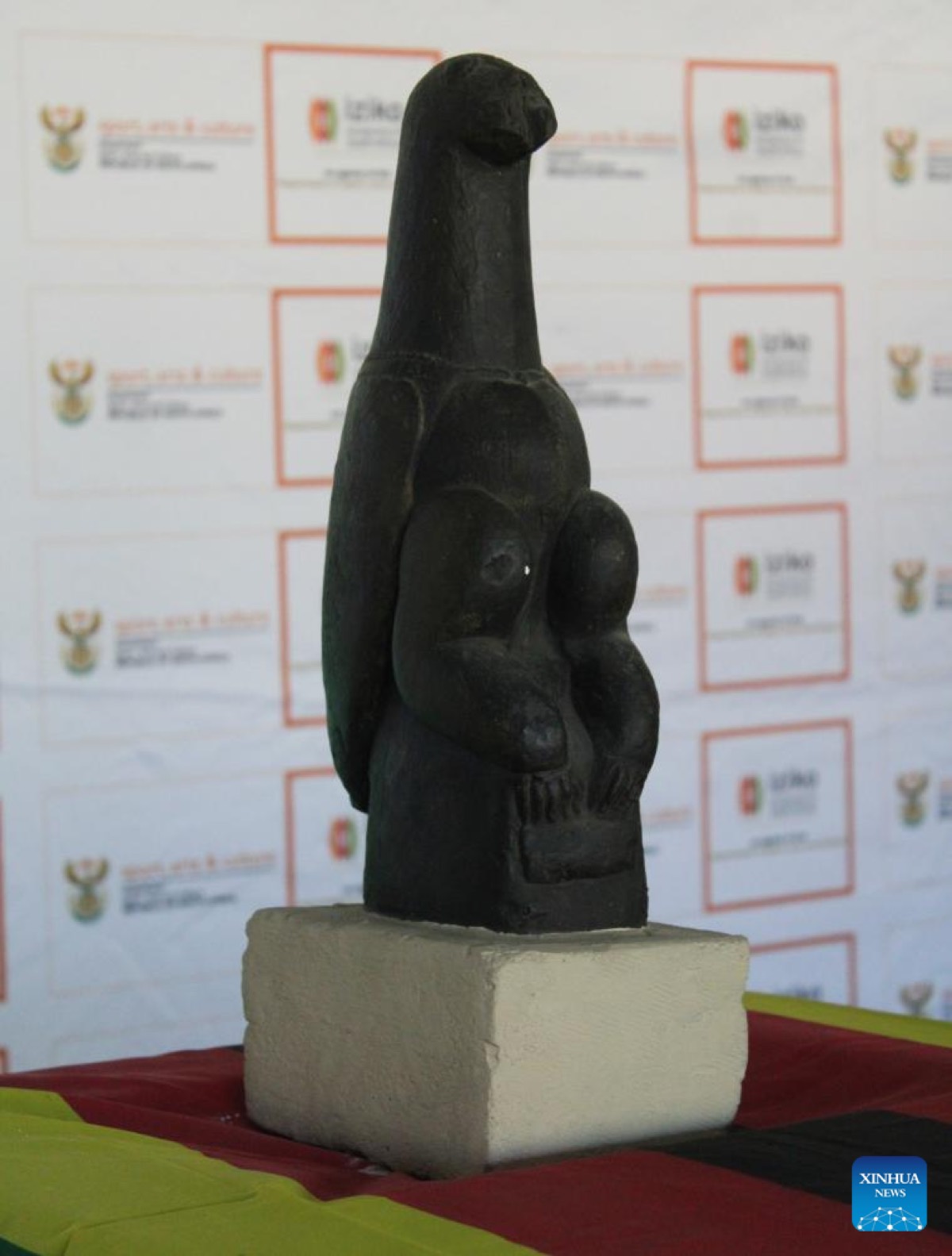
In April, the last of Great Zimbabwe's soapstone birds taken during the colonial era finally came back to the country. Five months later, six sculptors are showing a flock of their own in Bulawayo. Birds of Zimbabwe runs at Kori Studio in Ilanda until Friday 25 September, and it's one of the rare times a stone sculpture show of this kind has landed outside Harare.
This is the first story in September In Motion, our daily run to the end of the month of the people and projects that kept the local arts scene moving in September.
What's on show
According to Community Podium News, which previewed the exhibition before it opened, the six sculptors come from different parts of the country. Their work is built around indigenous birds: eagles, owls, hornbills and rollers. Alongside the single pieces there are triptychs and mixed-media works that deal with conservation, resistance and renewal, so this isn't only a room of decorative carvings.
The show is curated by Talent Kapadza, working under Kori Studio's lead curator, Dr T. Muganyi. Kapadza is an interesting choice. He's a resident artist at the National Gallery in Bulawayo whose own practice is painting and mixed media rather than stone, so he brings an outsider's eye to a tradition that has often been curated by and for sculptors alone.
The closing programme adds something practical. A lawyer from Tanaka Law Chambers is due to speak to artists about intellectual property, a topic that matters a great deal in a medium where designs are easily copied and resold.
Ward 26 councillor Mpumelelo Moyo told Community Podium that events like this have usually gone to Harare, and he welcomed Kori Studio as a modern venue for the city. The venue, at 16 Francis Warren Road, doubles as a café.
Why birds, and why now
The timing is hard to ignore. The BBC reported in April that the last Zimbabwe Bird held outside the country, removed from Great Zimbabwe in 1889 and later owned by Cecil Rhodes, had been returned from South Africa. It came back on a two-year loan, with permanent repatriation waiting on a change to South African law. All eight known birds are now in Zimbabwe.
Even the original carvings keep people arguing. The BBC notes that scholars still disagree on which bird they show: some say the bateleur eagle, or chapungu, and others the fish eagle, or hungwe. A contemporary show built around birds walks straight into that conversation about what the emblem means and who gets to interpret it.
The market these carvings are entering
Zimbabwean stone sculpture has a famous history, from Tengenenge in Guruve to the Chapungu collection, and the numbers suggest demand abroad is holding. NewZimbabwe, citing ZimStat figures via ZimTrade, reports that stone art exports rose to about US$1.65 million in 2025, up from about US$1.55 million in 2024.
The view from the workshops is less comfortable. Origins.zw visited Mawabeni, a carving community near Bulawayo, and found sculptors going weeks without a sale while the price of serpentine stone had nearly doubled in two years. On pricing, The World reported the case of a sculptor whose piece sold for US$650 was later resold for US$27,000. In the same report, Farai Muchemwa of the National Gallery urged artists to price for local buyers rather than only for Western collectors.
What it means for Bulawayo
A show like this won't fix the economics on its own, but it points in a useful direction. It gives carvers a local, gallery-style setting with an audience that isn't made up of tourists passing through a roadside market. It pairs them with a curator from outside the medium, and it puts an intellectual property talk on the programme. Getting those basics right is what separates a one-off exhibition from a scene that can support its artists.
For anyone in Bulawayo this week, it's a short window. The show closes on 25 September.
Sources
- Birds of Zimbabwe stone exhibition, a creative economy boost, Community Podium News
- Zimbabwe's iconic stone birds were taken by colonialists. Finally, they're all back home, BBC News
- Zimbabwe stone sculpture exports rise as global demand grows, NewZimbabwe
- Economic strain threatens Mawabeni's stone sculpture heritage, Origins.zw
- Zimbabwe's stone sculptors struggle to keep carving, The World
Researched and drafted with the help of AI tools, then fact-checked and edited by our team. How we work.