In August 1987, a band that had recorded its first single at Harare's Shed Studios five years earlier walked out in front of a packed Wembley Stadium to open for Madonna. It remains one of the most improbable crossover moments in Zimbabwean music history, and most people who've heard the story only know the Madonna part.
From Shed Studios to a sound of their own
The Bhundu Boys formed in Harare, cutting their debut single "Une Shuwa Here" at Shed Studios in August 1982 before signing a formal three year recording contract there the following February. What they were building was something new, "jit," a fusion of mbira rooted Shona chimurenga music with electric guitars, rock, disco, country and pop. It worked. The band scored four number one hits in Zimbabwe between 1982 and 1986, including "Baba Munini Francis" and "Hatisitose."
How the UK found them
The Bhundu Boys' breakthrough abroad didn't come through a label pitch, it came through a Discafrique EP that landed with BBC DJs John Peel and Andy Kershaw in autumn 1985. Peel, one of British radio's most influential tastemakers, championed the band from there, and is reported to have been moved to tears the first time he saw them play live in 1986. The Guardian later ranked Peel's championing of the Bhundu Boys among its list of 50 key events in the history of world and folk music.
That momentum led to a deal with Warner Bros/WEA in October 1986, worth an 80,000 pound advance, and a UK chart run built on raw, road tested energy that had already won over British audiences the hard way, through relentless touring.
The Wembley moment
By 1987, that touring circuit had put the Bhundu Boys on Madonna's radar. Concert listings from the period place the band on the bill supporting Madonna alongside Level 42 and Hue and Cry at Wembley Stadium in August 1987, at the height of her Who's That Girl tour and the height of the band's own UK profile. For a group that had been recording in a shed in Harare five years earlier, it was about as big a stage as British music had to offer.
A harder chapter
The years that followed were not kind to the band. Several original members died young, including bassist David Mankaba in 1991 and Shepherd Munyama in 1992, and former frontman Biggie Tembo, who had already left the band, died in 1995 following a period of illness. Rise Kagona, the founding guitarist who kept the band's music alive the longest, died in Scotland in September 2024, leaving Kenny Chitsvatsva as the last surviving original member. A fundraiser followed to bring Kagona's body home to Harare for burial, a reminder of how far the Bhundu Boys' story had travelled from Shed Studios, and how much it had cost the men who lived it.
Why it still matters
The Bhundu Boys' catalogue lives on through reissue compilations like The Shed Sessions. Later Zimbabwean acts working in jit still point back to Wembley as proof that a Harare sound could fill a British stadium.
Sources
- Bhundu Boys, Wikipedia
- Bhundu Boys, John Peel Wiki
- Madonna / Level 42 / Hue and Cry / Bhundu Boys at Wembley Stadium, August 1987, Concert Archives
- Please Welcome the Bhundu Boys, MadonnaTribe
- Obituary: Rise Kagona (1960-2024), Songlines
- Scottish Inner Circle Mourns Bhundu Boys Founder Rise Kagona, Nehanda Radio
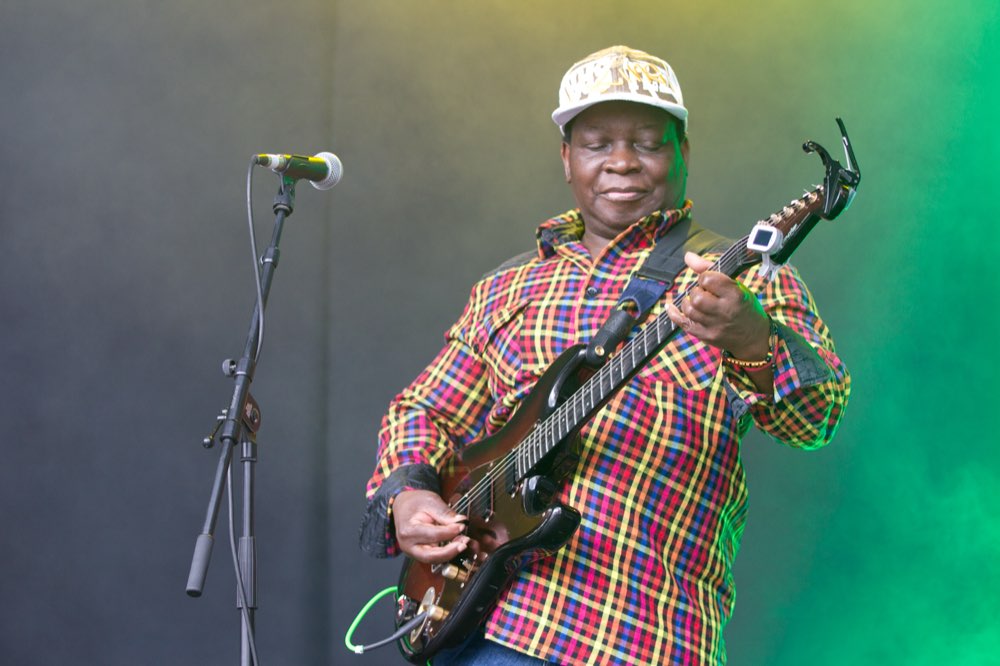
Photo by Zul Bhatia (courtesy of Andy Cooke), via Songlines.
Researched and drafted with the help of AI tools, then fact-checked and edited by our team. How we work.