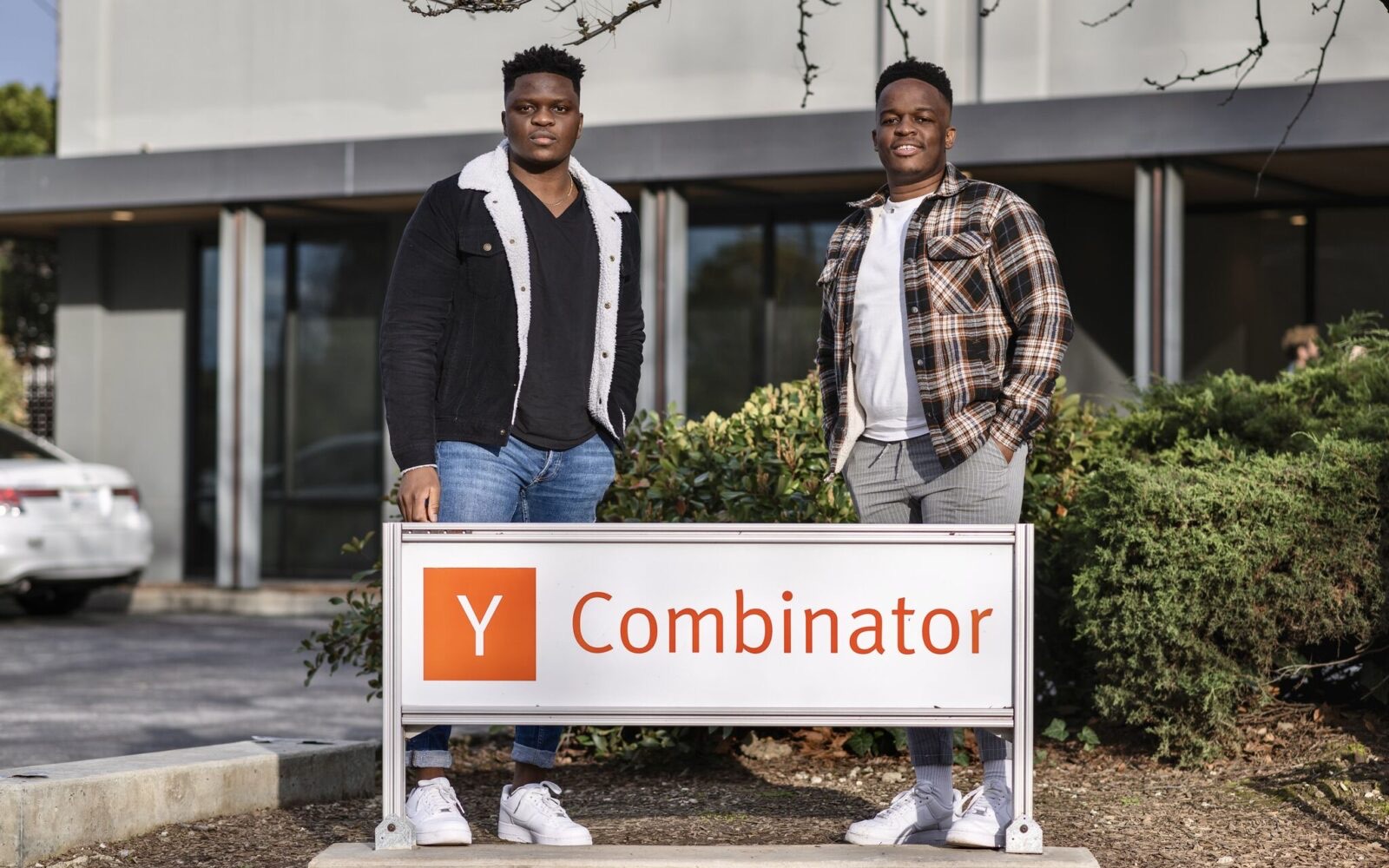
Two Dartmouth graduates, one from Zimbabwe and one from Zambia, have raised $2 million for a company that does something most people never think about: it checks whether AI actually understands people when they talk.
Ocular AI announced the pre-seed round this week. Drive Capital led it, with Y Combinator, Alumni Ventures, 1745 Ventures, Orange Collective, MyAsia VC and a group of angel investors joining in, according to Dealroom. Louis Murerwa, the chief technology officer and a former Google engineer, grew up in Zimbabwe. Michael Moyo, the chief executive, who worked at Microsoft, is Zambian. Techzim pointed out that Ocular is really an American company, started in the US by two Africans. It is based in San Francisco and has eight staff, according to its Y Combinator profile.
They started out building something else
When Ocular first appeared at Y Combinator in early 2024, it had nothing to do with voice. Its launch post described an enterprise search tool, a Google-style search box with a copilot that could look across a company's Slack, Notion, Jira and Google Drive and act on what it found.
That market got crowded fast. Every large software company shipped its own AI assistant, and a small team selling search was up against all of them. Ocular moved to a different part of the AI business, the part underneath the apps. It now calls itself an "applied AI data research lab". It builds the datasets that AI models are trained on, and the tests, or benchmarks, that show whether those models work.
It's an old lesson in new clothes. During a gold rush, the steadiest money often goes to the people selling picks and shovels. Every AI lab in the world needs good data and honest tests, and most can't make enough of either themselves.
Why voice is the hard part
Ocular started with voice. When speech is turned into text, a lot gets lost: tone, timing, pauses, people talking over each other, accents. A voice assistant that only learned from clean transcripts falls apart in a real conversation, whether that's a busy kombi rank or a family WhatsApp call where three people talk at once.
The company makes a striking claim here. It says nearly all open voice models that can listen and speak at the same time still rely on a telephone recording collection made in 2004, at 8kHz, roughly the sound quality of an old landline call, Dealroom reports. Ocular's answer is to record conversations at studio quality, with each speaker on their own audio channel so overlaps can be pulled apart. In September it added a dataset that records two people on separate, synchronised audio and video, according to Business Tech Africa.
Its first benchmark, Converse-STT, measures how accurately speech-to-text systems handle real conversation rather than one person reading a script. Ocular says its data and tests are already used by leading AI labs and Fortune 100 companies, and that it has reached seven-figure revenue. Neither claim has been independently confirmed, and no customer has been named.
Whose accents, though?
Ocular sells itself on capturing accents. It hasn't said which ones.
That matters, because African voices are still thin on the ground in AI training data. The biggest push to fix that, the African Next Voices project funded mainly by the Gates Foundation with support from Meta, collected speech in 17 languages across Kenya, Nigeria and South Africa, its researchers wrote in The Conversation. Ndebel and Shona aren't on the list. The project's isiNdebele is South Africa's Ndebele, a separate language.
The researchers behind African Next Voices put the stakes plainly. If a language isn't in the training data, the people who speak it get left out of the products built on that data. A Zimbabwean-founded company that specialises in accents is one of the better-placed outfits in the world to change that. Whether it does depends on what its customers pay for.
The people behind the data
Ocular's other selling point is its Expert Network, thousands of vetted specialists who help decide what a correct answer looks like. Its data is checked by doctors, linguists, lawyers, engineers and native speakers, who are paid "commensurate with their skill", according to a profile by ContentEdge. The company hasn't published rates or said where those experts are.
That is the upmarket end of a trade that Africa already knows from the other side. In April, Sama told more than 1,100 workers at its Nairobi centre that their jobs were going after its contract with Meta ended, TechCabal reported. Kenya had promoted that sort of AI data work as a source of jobs for young people. Ocular's model is the opposite bet: fewer people, more skill, higher pay per hour. For African professionals, a nurse in Bulawayo or a linguist in Lusaka, that is a kind of remote work that didn't exist five years ago. It is also a reminder of how far the value sits from the people providing it. The recordings, the benchmarks and the revenue all land in San Francisco.
What Zimbabwe is offering founders like these
Zimbabwe launched its National Artificial Intelligence Strategy 2026 to 2030 on 13 March. On paper it has a lot for this kind of founder. It plans a national AI regulator inside POTRAZ, a testing sandbox called the Innovation Crucible, a national AI and data platform called Project Pangolin, an innovation fund, and a "Come Home to Build" programme aimed at the diaspora.
A reading of the strategy by Harare legal technology specialist Tashinga Magaya, published in Business Times in June, found that none of the proposed bodies yet has a law behind it. She also found no costed budget, and said the diaspora programme wasn't yet visible in practice. A strategy approved by Cabinet sets a direction, she notes, but it can't bind anyone.
The local money is real but small. We looked at Zimbabwe's own AI funding challenge when a pan-African programme opened last month, and the gap between what's on offer at home and a $2 million cheque from a US venture firm is wide. For a Zimbabwean engineer with a Dartmouth degree and a Google CV, the path of least resistance still runs through San Francisco.
And the continent? No safety institute yet
The work Ocular sells, testing AI systems against the real world and publishing the results, is the core job of government AI safety institutes elsewhere. Britain, the United States, Japan, Singapore and others have one.
Africa doesn't, not in that form. The African Union's Continental AI Strategy, endorsed by its Executive Council in Accra in July 2024, isn't binding on member states. A 2025 report by the Global Center on AI Governance found that only Kenya, Ghana, Morocco, Rwanda and South Africa showed meaningful activity on AI safety, and that no African country hosts a dedicated safety institute. Kenya comes closest. It was among the founding members of the International Network of AI Safety Institutes in San Francisco in November 2024, joining through a government office rather than a standalone institute, according to the network's mission statement.
The AU is moving, slowly. In April its Peace and Security Council asked the AU Commission to speed up an African Fund for AI that would also finance startups and youth-led tech firms. It told the Commission to explore an African Centre of Excellence on AI, and backed a network of national AI centres. Neither the fund nor the centre exists yet. The same communiqué called for data localisation, keeping African data on African soil. That sits awkwardly next to a company like Ocular, which turns recorded human conversation into value from an office in California.
The Global Center report also recommended multilingual testing for at least 25 African languages. That is exactly the kind of benchmark Ocular builds for a living. At the moment, no African institution is building it.
What it means
For African founders, the takeaway is that the AI business is bigger than chatbots and apps. Data, testing and human expertise are businesses in their own right, and two Southern Africans just raised $2 million to prove it.
For governments, the question is whether the continent will build any of that testing capacity itself, or keep relying on private labs abroad to decide whether AI understands an African speaker. The things to watch are the AU's AI fund and centre of excellence, the bill that would give Zimbabwe's AI regulator real powers, and whether Ocular's next dataset has a Ndebele or Shona speaker in it.
Sources
- Ocular AI raises $2M pre-seed to feed frontier AI the voice data it lacks, Dealroom
- Zimbabwean Entrepreneurs Raise $2 Million for AI Data Startup Ocular AI, Business Tech Africa
- This Zimbabwean/Zambian startup was accepted into Y Combinator, Techzim
- Ocular AI: bringing enterprise search, gen AI and actions to the workplace, Y Combinator
- Ocular AI company profile, Y Combinator
- Ocular AI pays doctors and linguists to train voice models, ContentEdge
- African languages for AI: the project that's gathering a huge new dataset, The Conversation via Down To Earth
- Sama to lay off over 1,100 Kenyan workers after Meta contract ends, TechCabal
- Strategy without statute: a reading of Zimbabwe's national AI strategy, Business Times
- African Union committed to developing AI capabilities in Africa, African Union
- Toward an African Agenda for AI Safety, Global Center on AI Governance
- Communiqué on Artificial Intelligence: Governance, Peace and Security, AU Peace and Security Council
- International Network of AI Safety Institutes mission statement, NIST
Researched and drafted with the help of AI tools, then fact-checked and edited by our team. How we work.