
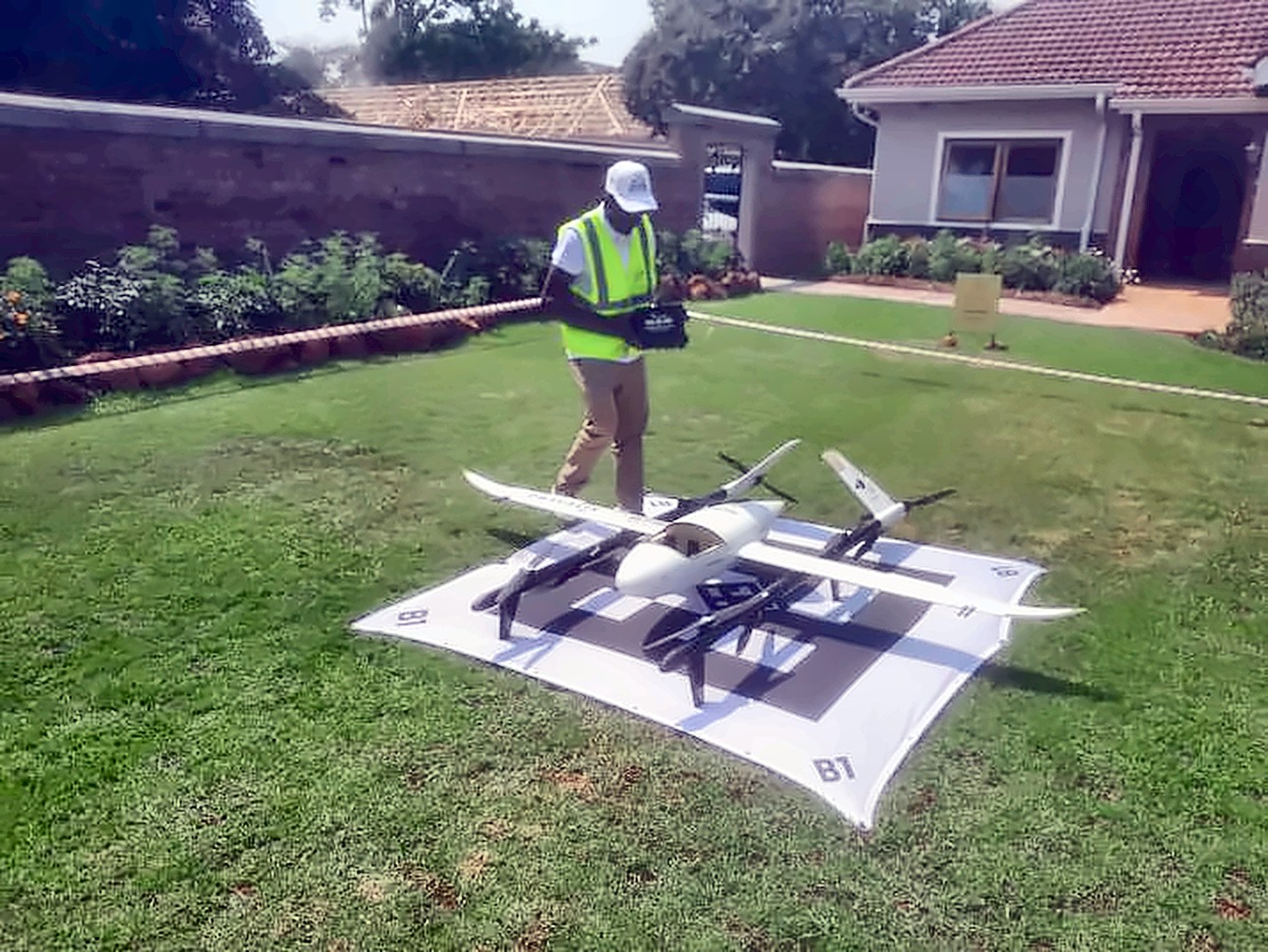
Last week a small fixed-wing drone left a hospital in Belgravia, Harare, carrying medicines to Marondera, then flew back with a blood sample for the lab. The round trip covered about 150 kilometres in roughly 70 minutes. It's an impressive bit of flying, but the bigger story is what it adds up to: two separate drone launches in the space of a fortnight, one for healthcare and one for the post office, both pointing at the same question. Could this become a normal way to move things around Zimbabwe?
The Harare to Marondera flight
The trial was run by Drone Solutions (Pvt) Ltd and private healthcare group HealthPoint. According to Pan African Visions, the drone flew 76 kilometres from HealthPoint Hospital on Lanark Road to HealthPoint's Borradaile Hospital in Marondera, then carried a blood sample 74 kilometres back to the group's Upper East Road Diagnostics Laboratories. The route was approved by the Civil Aviation Authority of Zimbabwe (CAAZ).
The aircraft, a Kite Aero, is built for small and urgent loads. It carries up to 4kg, cruises at 120km/h and has a maximum range of 277km depending on payload and conditions. That 4kg ceiling rules out bulk freight, but blood samples, vaccines, test kits and most emergency medicines fit comfortably.
HealthPoint CEO Peter Annesley framed it around speed, saying getting medical products to patients as early as possible is central to saving lives. Drone Solutions CEO Jeremiah Musabayana was careful to say drones aren't meant to replace road transport, only to "make distance less of a barrier to access" where they genuinely help.
Zimpost wants in too
The medical flight builds on a partnership announced a couple of weeks earlier. On 10 October, World Post Day, Zimpost and Drone Solutions launched a drone parcel delivery service at Bambadzi in Bulilima District, Matabeleland South. ICT, Postal and Courier Services Minister Tatenda Mavetera dispatched a package to Masendu, and the drone came back with a gift pack for her.
Pan African Visions reports the plan is to plug drones into Zimpost's existing network of more than 230 agency locations, opening up delivery for businesses, communities and public institutions. Suggested uses range from urgent parcels and lab supplies to humanitarian consignments and industrial spare parts. Musabayana described the goal as moving beyond one-off drone flights to a scalable, commercially viable delivery system.
Postmaster-General Maxwell Chitendeni positioned it as part of a wider modernisation push, and The Granite Post reports he also outlined plans to bring artificial intelligence into Zimpost's network to plan more efficient delivery routes in urban areas.
So is it going countrywide?
Not yet, and nobody has put a date on it. Here's how the timeline actually looks:
- April 2026: Drone Solutions announced what it called a nationwide medical drone delivery programme, prioritising vaccines, blood products, pathology samples and anti-rabies and maternal health medicines, NewsDay reported.
- August 2026: The company completed its demonstration flight programme.
- September 2026: CAAZ granted beyond-visual-line-of-sight approval, which Business Insider Africa described as the shift from demonstrations to daily delivery operations.
- 10 October: Zimpost parcel launch in Bulilima.
- Last week: The Harare to Marondera medical round trip.
What comes next is less clear. The companies say the HealthPoint trial will feed into further evaluation of whether regular flights are workable, subject to safety requirements and regulatory approvals. The Granite Post points out that Zimpost hasn't confirmed delivery charges, maximum parcel weight, operating distances or a timetable for rolling the service out, and that the Bulilima flight doesn't mean a national network is running. Minister Mavetera herself stressed at the launch that aviation approvals, safety, reliability and cost would need to guide any expansion, and that anything involving medical supplies would need health authorities on board.
Techzim raised a similar flag back in April, noting that the company's announcement made big claims about scale and regional expansion but left it unclear how much was operating on the ground versus still being rolled out.
What it could mean if it works
The two-way medical model is the most interesting part. A single aircraft dropping off medicine and returning with a sample means a rural clinic could restock and send off diagnostics in the same trip, rather than waiting for a vehicle to make the run to a city lab. NewsDay notes the biggest impact is expected in rural areas where flooding and damaged roads cut clinics off during the rainy season, which is exactly when a road-based supply chain is weakest.
For Zimpost, drones offer something different: a reason for the postal network to matter again in an era when letters have largely disappeared. Plugging aircraft into 230 existing locations is cheaper than building a delivery network from scratch, and lightweight, time-sensitive items like documents, spare parts or agricultural inputs are a natural fit.
The open questions are the ones that decide whether any of this becomes everyday infrastructure. What does a delivery cost, and can a rural clinic or small business afford it? Who pays when the customer is a public health facility? Can the operation stay reliable through the rainy season, the very conditions it's meant to beat? Rwanda's experience with Zipline, which we've covered before, shows medical drone networks can work at national scale in Africa, but it took a government contract and years of operation to get there.
For now, Zimbabwe has the hardware, the regulatory approval, trained pilots and two high-profile proofs of concept. The next milestone to watch for is a named route running on a regular schedule with a published price. That's when this stops being a demo and starts being a service.
Sources
- Drone Solutions and HealthPoint Pilot Two-Way Medical Drone Deliveries Between Harare and Marondera, Pan African Visions
- Drone Solutions Launches Zimbabwe's First Drone Postal Service, Pan African Visions
- Zimpost Launches Drone Delivery Service in Rural Zimbabwe, The Granite Post
- Drone rollout to cut medical delivery times to under 30 minutes in Zimbabwe, NewsDay
- Zimbabwe clears drones to deliver vaccines, blood and medicines, NewZimbabwe (Business Insider Africa)
- Drones to deliver blood and vaccines in Zimbabwe if this takes off, Techzim
- Zipline (drone delivery company), Wikipedia
Researched and drafted with the help of AI tools, then fact-checked and edited by our team. How we work.