
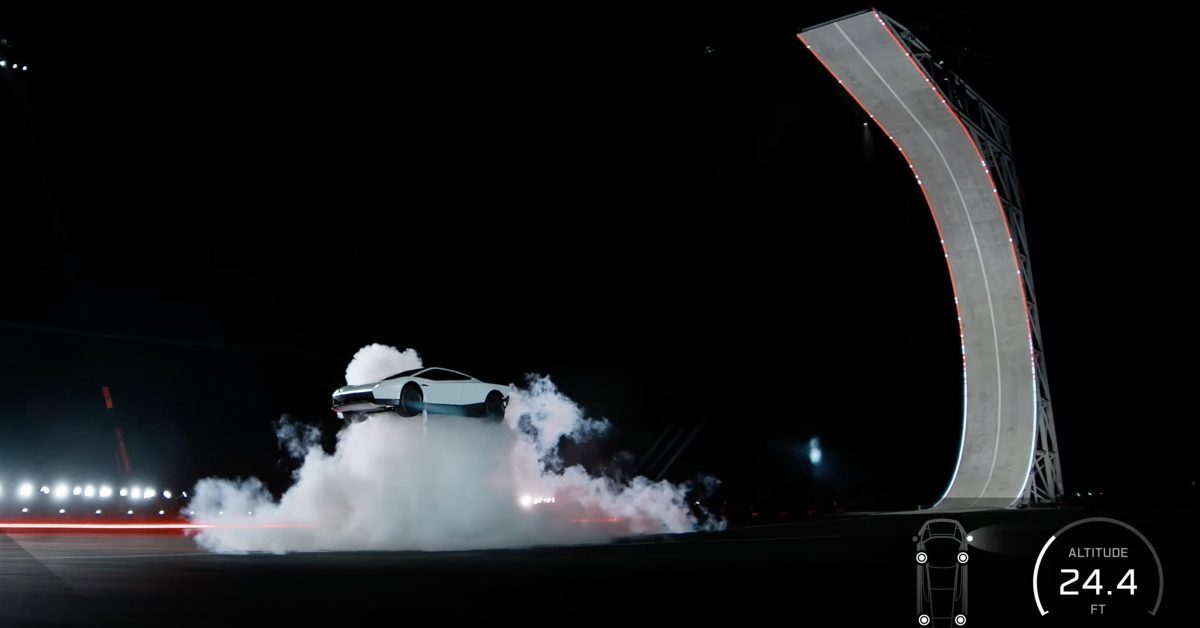
Tesla has been promising a new Roadster for nearly a decade, and on Thursday night, 15 October, it finally left the ground. At a livestreamed event at SpaceX's test site in McGregor, Texas, the car drove up a towering curved ramp, clung to it upside down, launched off the end, flipped in mid-air and landed. "Turns out the future does have flying cars," Musk told the crowd, Fox Business reports.
What Tesla actually showed
Two systems did the work. Tesla's vice president of vehicle engineering, Lars Moravy, explained that a fan suction system under the car pulls it against the surface hard enough to drive upside down, and Musk said the car carries altitude control thrusters plus main thrusters at the rear, with SpaceX technology handling the rest, according to Euronews. In a second stunt, a Roadster jumped a row of cars and a truck and flipped over them before landing.
Tesla also claimed a 0 to 60 mph time of under one second and a top speed above 230 mph for the top version. There are three trims: Performance, Thrust and Rocket. Only the Rocket, a single-seater with the full flight system, does what the crowd saw, and it is available by invitation only. Musk joked that it is "not necessarily a safety optimised car".
The skeptics have a point
Electrek's technical breakdown is the sharpest reality check. The thrusters run on compressed gas stored in onboard tanks, nobody was inside the cars during either stunt, and none of the headline numbers, from the acceleration to the 300-mile range, have been tested independently. It also notes that Tesla itself says the Rocket is not approved for public road use, and it raises plainer worries: gas plumes reaching tens of metres, debris flying at bystanders, and what a pressurised tank does in a crash.
Then there is the law. As Yahoo Autos points out, US aviation rules generally treat anything airborne as an aircraft, with electric vertical take-off aircraft getting their own special framework. A stunt on a closed SpaceX site under flight restrictions does not show that owners will ever be allowed to hop over traffic on a public road. A car that is also an aircraft would need to satisfy road regulators and aviation regulators at the same time, and no country has a ready-made rulebook for a sports car with rocket thrusters.
Why the future usually finds a way
Still, the "this can never be legal" argument has a long and losing history. When steam-powered road vehicles appeared in Britain, the Locomotive Act of 1865, better known as the Red Flag Act, required a crew of three, one of whom had to walk at least 60 yards ahead waving a red flag, with speed capped at 4 mph on open roads and 2 mph in towns. Thirty years later, the Locomotives on Highways Act 1896 freed light vehicles from those rules and treated them as ordinary carriages. The law did not invent the car. It caught up with it.
Something similar is already happening with flying vehicles, just more quietly than a Tesla launch. In China, the aviation regulator has proposed a first batch of passenger eVTOL makers that will get simplified certification, CnEVPost reports, among them Xpeng's Aridge, whose Land Aircraft Carrier hides a two-seat aircraft inside a ground vehicle and has roughly 7,000 pre-orders at under 2 million yuan each. That is the boring, paperwork-heavy route to flying cars, and it may well get there before Tesla does.
What it means from here
For now, nobody in Zimbabwe will be booking a Roadster that flies over the Samora Machel Avenue traffic. Even the ground-bound Performance version needs a $50,000 deposit, and production is not due until 2028. Any flying version would also have to answer to the Civil Aviation Authority of Zimbabwe as well as our road traffic rules, and neither was written with a thruster-equipped sports car in mind.
But the reveal matters because it moves the conversation. Regulators tend to write rules for things that exist, not things that are promised, and on Thursday a car left the ground in front of a live audience. Whether Tesla's version is a genuine product or an expensive party trick, the question has shifted from "will flying cars happen?" to "who gets to set the rules when they do?" If the Red Flag Act is any guide, the answer arrives later than the machines, but it does arrive.
Sources
- Tesla's new Roadster takes flight during dramatic unveiling at SpaceX facility, Fox Business
- 'Well, it worked': Elon Musk unveils new Tesla Roadster that can fly, Euronews
- Are Tesla's claims for its new 'flying' Roadster real, or is it just full of cold gas?, Electrek
- Elon Musk's Flying Tesla Roadster Is Real, but There's a Catch, Yahoo Autos
- Xpeng flying car unit gets certification boost as China unveils eVTOL compliance list, CnEVPost
- Locomotive Acts, Wikipedia
Researched and drafted with the help of AI tools, then fact-checked and edited by our team. How we work.