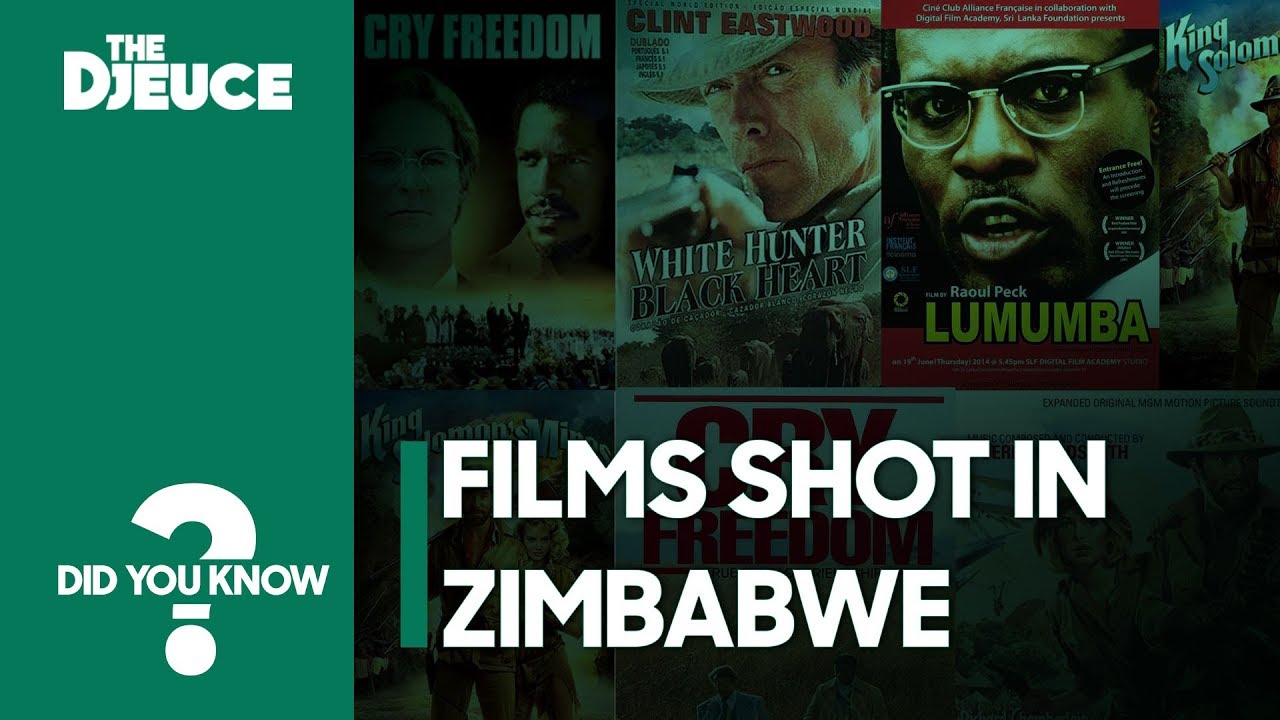
Zimbabwe's film industry has had its fair share of highs and lows, but from the mid 1980s to the early 2000s a run of major international productions, many with A-list casts, were shot in the country, several of them precisely because neighboring South Africa was off-limits to foreign crews under apartheid. After independence in 1980, the government actively courted these productions, and Zimbabwe's locations, from Harare and Bulawayo to Kariba, Hwange and Victoria Falls, did the rest.
The big four
- King Solomon's Mines (1985), the Cannon Films adventure starring Richard Chamberlain and Sharon Stone, made on a $7 million budget that returned roughly $80 million at the box office.
- Cry Freedom (1987), Richard Attenborough's drama about the death of anti-apartheid activist Steve Biko, filmed in Zimbabwe after the crew was placed under surveillance by South African security forces. It earned Denzel Washington his first Oscar nomination, for Best Supporting Actor.
- A World Apart (1988), an anti-apartheid drama starring Barbara Hershey, filmed in northeastern Zimbabwe because South Africa's own apartheid government made filming there impossible. At Cannes, its Best Actress prize was shared by Hershey, Jodhi May, and Linda Mvusi, the first Black actress to win the award.
- White Hunter, Black Heart (1990), Clint Eastwood's film about a director loosely based on John Huston, shot around Kariba, Victoria Falls, and Hwange over two months in 1989.
More productions that were shot here
The four above are the best known, but they were far from the only ones. Others include:
- Allan Quatermain and the Lost City of Gold (1986), the sequel to King Solomon's Mines, shot near Victoria Falls at the same time as the first film, with Chamberlain and Stone back and James Earl Jones joining the cast.
- A Dry White Season (1989), Euzhan Palcy's apartheid-era drama with Donald Sutherland, Susan Sarandon and Marlon Brando, shot at Pinewood Studios in England and on location in Zimbabwe. Brando earned an Oscar nomination for Best Supporting Actor and reportedly worked for union scale pay.
- The Power of One (1992), the screen adaptation of Bryce Courtenay's novel about a boy in 1930s South Africa, an international co-production made on a reported $18 million budget with Zimbabwe among its filming locations.
- A Far Off Place (1993), Disney's adventure film starring a young Reese Witherspoon, which used the Shamva gold mine outside Harare for some scenes.
- Bopha! (1993), Morgan Freeman's directing debut, with Danny Glover as a Black policeman in apartheid South Africa, shot in Zimbabwe.
- Lumumba (2000), Raoul Peck's biopic of Congo's first prime minister, shot in Zimbabwe and Beira, Mozambique, because conflict in the Democratic Republic of Congo made filming there impossible.
Also shot here in the same era, according to film databases, were the HBO drama Mandela (1987), the adventure comedy Jake Speed (1986) and The Lost World (1992), and in 2010 the documentary Motherland included Zimbabwe among its African filming locations.
The pattern is the same throughout. Zimbabwe kept being cast as somewhere else, usually South Africa, sometimes Congo, because it had the landscape, the infrastructure and the politics that let a film crew work.
What it did for the local industry
The effect on Zimbabwe's own film sector was real but mixed.
Work and experience. Visiting productions hired local crew and extras, and some Zimbabweans built long careers off them. Filmmaker and actor Steven Chigorimbo has credits on King Solomon's Mines, Jake Speed and Cry Freedom, and went on to work on more than a hundred projects and to produce the long-running soap Studio 263. In 2006 the Zimbabwe International Film Festival Trust gave him a service award for his contribution to the industry.
A government strategy. After independence the government promoted Zimbabwe as a place for foreign companies to shoot, and teamed up with Universal Pictures on Cry Freedom, hoping Hollywood's presence would build local skills. Scholars who have studied the period argue it did not deliver the way it was meant to. The big films' returns to Zimbabwe were modest, and the government later pulled back from supporting local production, which left the industry leaning on the Hollywood model rather than building one of its own.
Training and homegrown hits. Not all the money was foreign studio money. Germany helped fund a film training and production programme, and the American nonprofit Media for Development International bankrolled local, message-driven films until 2000. The result was the 1990s, widely seen as Zimbabwe's strongest filmmaking decade. Neria (1991), written by Tsitsi Dangarembga and directed by Godwin Mawuru, with a soundtrack by Oliver Mtukudzi, became the highest-grossing film in Zimbabwean history.
The drop-off. When Media for Development International left in 2000, foreign investment largely dried up, and the big productions stopped coming. Filmmakers turned to cheap, fast, Nollywood-inspired "Zollywood" productions, and the cinema infrastructure shrank with them: by 2021 only 13 cinema screens operated nationwide, against 14 cinemas in Harare alone in the 1980s.
The Grand Tour's farewell, filmed in Zimbabwe
The most recent big international production to use the country is also one of the most visible. The Grand Tour: One for the Road, the final episode ever presented by Jeremy Clarkson, Richard Hammond and James May, was filmed in Zimbabwe in September 2023 and released on Prime Video on 13 September 2024, ending a partnership that began on Top Gear in 2002.
The trio set off in three cars they had always wanted to own, a Lancia Montecarlo, a Ford Capri and a Triumph Stag, driving through the Eastern Highlands and Honde Valley, to Harare, Kariba and Mana Pools, and on to Victoria Falls before crossing into Botswana to finish on Kubu Island, where they shot their first ever special in 2005. The Victoria Falls Bridge was closed for filming in what an advertisement described as a government-sanctioned project, and a long list of Zimbabwean safari operators, restaurants, medical teams and hospitality businesses supported the shoot. Clarkson thanked "the people and government of Zimbabwe" afterwards and the country was called "the best for last" in coverage of the episode.
Clarkson had said years earlier that he loved filming in southern Africa and hoped to shoot in Zimbabwe once that became possible, and the BBC was reportedly never allowed to film there. That timing is part of why the episode is being read as a signal. A show with an audience across more than 240 countries chose Zimbabwe as the backdrop for its farewell, and local designers and operators said it put the country back on the map. Tour companies moved fast, with Mavros Safaris, the production's logistics partner, selling expeditions that follow the filming route, one reported at around R400,000 per person.
Whether it turns into a wave of bigger productions is still an open question. So far the clearest payoff has been tourism, not film. The 1980s showed that a famous crew in town does not by itself build an industry. What the Grand Tour did show is that a major international crew can work in Zimbabwe at scale again, on the logistics, permits and local suppliers that the Film Strategy is trying to formalize.
Where that leaves things now
Foreign crews have not entirely stopped coming, and some local companies now sell Zimbabwe as a location and supply the permits, logistics and crews that visiting productions need. But the Hollywood era is best read as a lesson more than a legacy. Productions that borrow the country as a backdrop leave behind jobs, a few careers and some memorable credits, while the infrastructure, funding and distribution a lasting industry needs have to be built by Zimbabweans. That is the gap the country's first formal Film Strategy, launched in 2024, is trying to close.
Sources
- King Solomon's Mines (1985 film), Wikipedia
- Allan Quatermain and the Lost City of Gold, Wikipedia
- Cry Freedom, Wikipedia
- A World Apart (1988 film), Wikipedia
- A Dry White Season, Wikipedia
- White Hunter, Black Heart, Wikipedia
- The Power of One (film), Wikipedia
- A Far Off Place, Wikipedia
- Bopha!, Wikipedia
- Lumumba (2000 film), Wikipedia
- Neria (film), Wikipedia
- The Grand Tour, Wikipedia
- Behind the scenes of The Grand Tour: One for the Road, Great Zimbabwe Guide
- Clarkson, May and Hammond filming The Grand Tour in Zimbabwe, ZimLive
- The Grand Tour Finale puts Zimbabwe tourism on the global map, Bulawayo24
- Prime Video unveils first look at final episode of The Grand Tour, NewZimbabwe
- Cinema of Zimbabwe, Wikipedia
- Steven Chigorimbo, Wikipedia
- The Post-Independence Development of Film in Zimbabwe, Postcolonial Web
- Zimbabwe Film Strategy 2025-2030 launched, IFACCA
Researched and drafted with the help of AI tools, then fact-checked and edited by our team. How we work.