A few weeks ago, The Djeuce wrote about a place that had just opened at Westgate called Reality Shift. We were upfront in that article: we knew it was there, but we hadn't experienced it, so we couldn't rate it. The team read it and invited us in to see for ourselves. I took the tour, and Laura from the Reality Shift team looked after me and walked me through 14 of their exhibits. Here's how it went.
Video coming soon: I filmed the tour, and a video walkthrough of Reality Shift is on the way. We'll add it to this article as soon as it's ready.
The Ames room: where I became a giant
My first stop was the Ames room. You stand across from someone, and because of how the room is built, one of you looks bigger than the other. In my case I looked like a giant next to the young lady standing opposite me.
Here's the funny part: you can't see it while you're in there. It's only when you look at the photo that you go, "oh, snap, this is what it looks like." That's why it helps to have a guide lining up the shot for you.
It's an old trick, too. The first Ames room was built in 1946 by the American ophthalmologist Adelbert Ames Jr., who wanted to show how much of what we see is our brain filling in assumptions. The room only looks like a normal box from one spot. Its real shape is a slanted trapezoid, and your brain refuses to believe a room could be that strange, so it adjusts the people instead.
The swirl tunnel: the one that fights back
Next we went to the swirl tunnel, and I have to warn you about this one. It might look attractive, but it is the biggest challenge of all the exhibits. You have to walk through the tunnel and make it to the other end in one piece.
I won't lie to you. After I tried it, it took me a few minutes to get my composure back. I almost crawled to the other end because I got so dizzy. It was hectic.
That's the design doing its job. The walls spiral around you, so your eyes tell your brain you're moving, while your feet on the bridge and your hands on the rails say you're standing still. Your brain usually trusts your eyes, so it decides the bridge is the thing that's moving. Hold the rails.
The infinity room: one for the ladies, and for dates
After that I went into the infinity room, which is a hit with the ladies. If you're on a girls' night or a girls' day out, it's a great place to link up and do a photo op. It works for couples too. If you bring a date, this place makes everything look really romantic. We spent some time in there and I took a couple of selfies.
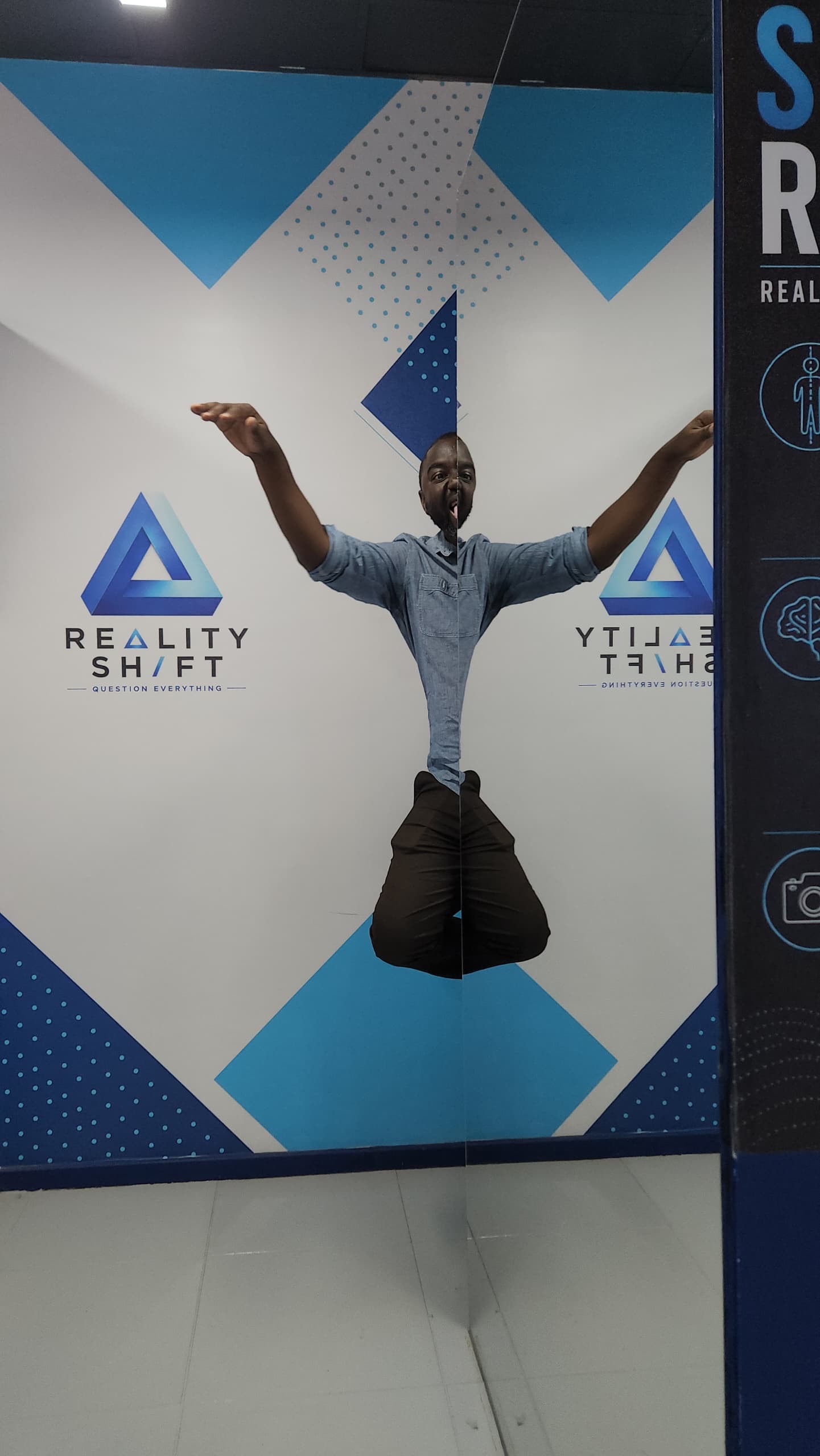
The upside-down room: the one I came for
There was one room I was really curious about, and that was the upside-down room. I've seen friends in South Africa take shots of themselves in places like that, and I always wanted to do it. So when I got my chance over here, I went for it and had a ball.
I have an idea here, and it's mine, not management's. If you have a vision for a unique album cover, or you want a unique clip for a music video, that room would work really well. I believe you could book a spot there and do a little shoot for a fee. There's room to do that.
The other side: puzzles and mind games
My tour was pretty much guided. Laura walked me through the quiet areas first, because the other areas were occupied and everyone else was having a good time. We went where people weren't, so I could shoot without making anyone uncomfortable.
After the upside-down room we went to the other side of the museum, and the pace changes. What's there is a lot more intellectual. There are puzzles and little mind games, and it almost feels like interactive learning. I was messing around with the colours, the puzzles and the little board games. There's one that resembled a game I constantly play on my phone, where you match balls in a row, and you only win after a huge string of matching balls lines up.
I'd have loved to take you through all 14 exhibits, but if you want to experience all of them, make the time, come to Westgate and bring your $15 per person.
My verdict
It was incredible, and time flew. I thought I'd spend maybe 10 or 20 minutes in there. By the time I checked the clock, I'd been there about an hour and a half without noticing. I also broke a sweat, because there's a lot of activity that comes with taking the poses and making your way through the rooms.
So, is it whack? No. Is it mid? No. Is it worth it? Absolutely. It's an experience, and a rare one in Zimbabwe. As far as I know, this is the first place in the country designed this way, and the team has promised me that they're going to add more exhibits and more games to make it more worthwhile.
A few reasons to go:
- It's good for families. Carve out some time with your family and have some fun.
- It's good for schools. It's a play on physics and science, so if you're a school that wants to add a bit of interactive learning to your programme, I think booking a day for your students would be a great opportunity.
- It's good for your socials. If you want to bring some life to your Facebook or Instagram, or do a proper photo dump, go and enjoy the experience and the ambience.
Before you go
- Where: Westgate Shopping Complex, Westgate Mall, Harare
- Hours: Monday to Sunday, 09:00 to 19:00
- Price: $15 per person, covering all 14 exhibits
- Contact: +263 790 034 005, info@realityshift.co.zw
- Socials: @realityshiftzw on TikTok and Instagram
- Set aside: about an hour and a half, and wear something you can move in
A special thank you to the Reality Shift team, Tariro and Laura. Please do pay them a visit, and have fun.
Peace.
Elliot
Sources
- Ames room, Wikipedia
- The Ames Room: The optical illusion that will make you doubt your eyes, ZME Science
- Vortex Tunnel: the illusion that challenges your balance, Museum of Illusions Madrid
- Reality Shift, official Instagram (@realityshiftzw)
- Reality Shift, official TikTok (@realityshiftzw)
- Elliot's on-site tour commentary, recorded at Reality Shift, Westgate
- Our first article: Reality Shift Has Opened in Westgate
Researched and drafted with the help of AI tools, then fact-checked and edited by our team. How we work.