Most chefs measure a good week in full tables. Zandi Mubi-Chitima just spent hers cooking at the headquarters of the UN's Food and Agriculture Organization in Rome, on the same programme as the FAO Director-General and a line of government ministers.
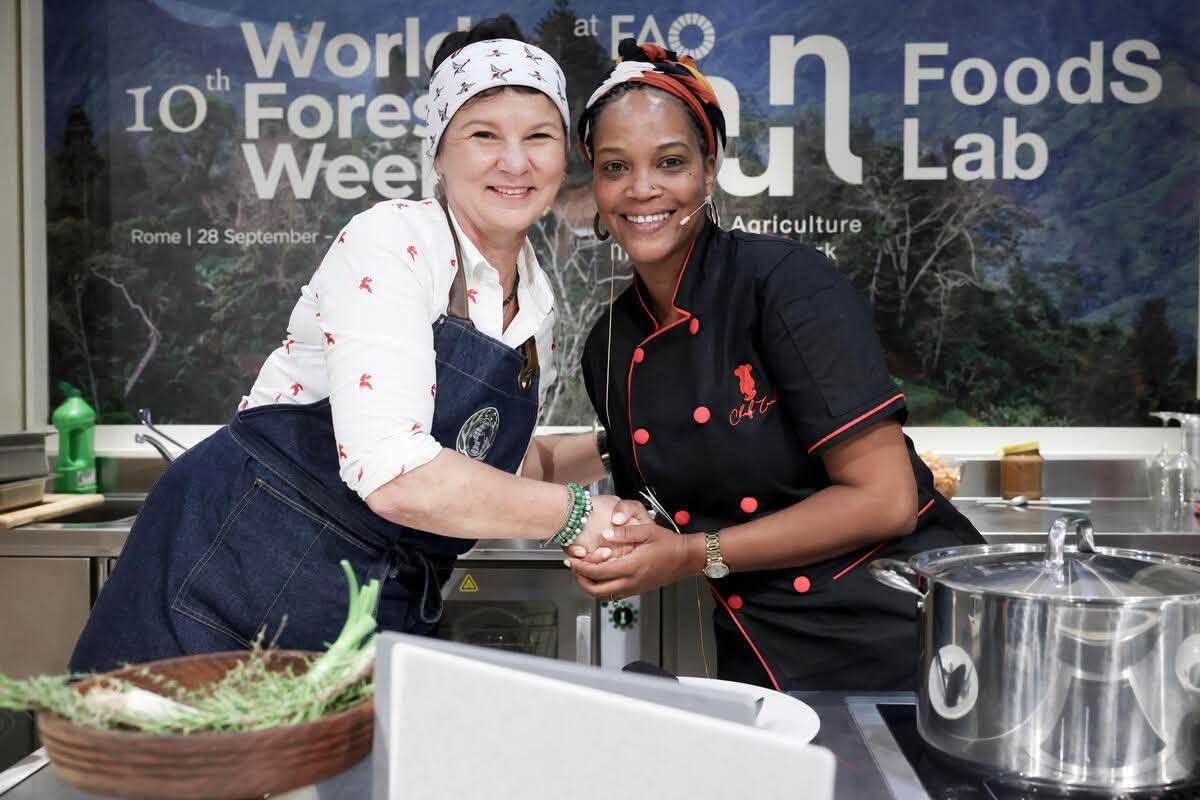
The Harare chef and restaurateur was invited to take part in the 10th World Forest Week, which ran from 28 September to 2 October alongside the 28th Session of FAO's Committee on Forestry, the highest intergovernmental body on forestry in the world. She appeared at two official events, and at both her job was the same: cook, and let the food make the argument.
Two events, one kitchen
The first was the week's opening high-level dialogue, "Forests, food and nutrition: sustaining people and the planet", held on Monday 28 September. According to FAO's event page, the session brought ministers and senior officials together to discuss how forests and trees feed people, then closed with a cooking demonstration of native Slovak and Zimbabwean forest foods. FAO's speaker list for the event names her as "Chef Zandi Mubi, Zimbabwe", alongside Slovak chef Soňa Chovanová Supeková, FAO Director-General QU Dongyu, and ministers from Zimbabwe, the Republic of the Congo, the Democratic Republic of the Congo and Bolivia.
Two days later the same pair of chefs were back for "From conflict to coexistence: protecting people, wildlife and forests", a session run by FAO's Sustainable Wildlife Management Programme. FAO describes the chefs' role there as showing the cultural, nutritional and culinary value of wild meat and forest foods through their own culinary traditions, a practical illustration of why the wildlife and forests being debated in the room are worth protecting.
Neither FAO's programme nor Mubi-Chitima's own account lists the specific dishes she prepared. Writing on Facebook after the events, she said only that she had showcased traditional Zimbabwean dishes, met Environment, Climate and Wildlife Minister Evelyn Ndlovu and her delegation, and been backed by fellow Zimbabweans in the room, support she called "truly an extraordinary experience."
The career behind the invitation
Rome did not come out of nowhere. A 2022 profile by Tatenda Kanengoni for Bird Story Agency, carried by The African Mirror, traces a career built largely on refusing to be told no.
Mubi-Chitima grew up in hospitality. Her parents run Londoners, a sports bar in Harare, and a family restaurant in Bulawayo, and she cooked with her mother long before a high school Food and Nutrition class turned it into a plan. She went on to study commercial cookery and hospitality management in Melbourne, Australia, and intended to stay on after graduating, until a visa problem sent her home in 2013.
Back in Harare, the profile reports, she was told while job hunting that a kitchen was a hard place for a woman. She worked in the kitchen at Londoners instead, started a catering company called Zandi Loves Food, and applied for a restaurant space at Alliance Française. She made the final two and lost. A year later she applied again and won it. "I don't take no for an answer," she told Bird Story Agency.
Chez Zandi Bistro and Wine Bar opened in 2015. When the first Covid lockdown closed the hospitality industry in 2020, she moved her stock home, cooked alone and did the deliveries herself, then reopened in a bigger space on Lanark Road in Belgravia. Along the way she reached the fourth round of the second season of "Battle of the Chefs: Harare" and was included in the Go Getter movement's "Founding 100" book of female trailblazers in Zimbabwe.
Today her restaurant's Facebook page lists it as Chef Zandi Restaurant, operating inside the Londoners in Avondale West with sit-in dining, takeaway and private catering. Her menus have long put traditional Zimbabwean dishes next to French and other Western cooking, which makes a brief built around native forest foods a natural fit.
Why a chef was in the room at all
It would be easy to read a cooking demonstration as the light entertainment after the speeches. This year it was closer to the point of the week.
World Forest Week 2026 ran under the theme "Forests for food, resilience and prosperity", and FAO used the opening of the Committee on Forestry to push a new global report on how directly forests feed people, whether through wild foods themselves or through the pollination, soil and water that farming depends on. The organisation's argument is that forest foods are undervalued in policy precisely because they are treated as something poor rural households fall back on, not as cuisine.
Putting a working restaurateur in front of ministers is one way to change that picture. Food that can be plated, served and enjoyed at a UN headquarters is harder to dismiss as subsistence. For Zimbabwe, where wild fruit, insects and game have always been part of how people eat, having that case made by a chef from Harare, with the country's environment minister on the same programme, is a meaningful piece of positioning.
What it could mean at home
The appearance has drawn little coverage at home so far, which undersells it. There are two reasons it deserves more attention.
The first is commercial. If forest foods are going to earn more for the rural communities that harvest them, somebody has to create demand for them in restaurants, at events and in export markets. Chefs are the people who do that, and a Zimbabwean chef now has a credential from the world's main forestry forum to point to when she puts those ingredients on a menu.
The second is about who gets seen. In the 2022 profile, Mubi-Chitima described attending Harare restaurateur lunches and rarely seeing another black woman who owned a restaurant. Four years later she was the chef FAO chose to represent a country's food traditions in Rome. For younger cooks weighing up whether the industry has room for them, that is a more useful answer than any speech.
What she cooked, and what happens to those dishes next, is the part of the story still to be told. It would be worth hearing it from her.
Sources
- High-level dialogue: Forests, food and nutrition, sustaining people and the planet, FAO
- From conflict to coexistence: protecting people, wildlife and forests, FAO
- FAO Committee on Forestry: Director-General urges better integration of forests into food security and development policies, FAO Newsroom
- Changing the menu: Zandi Mubi does a re-write, Bird Story Agency via The African Mirror
- Chef Zandi at Londoners Lounge and Restaurant, Facebook
Researched and drafted with the help of AI tools, then fact-checked and edited by our team. How we work.